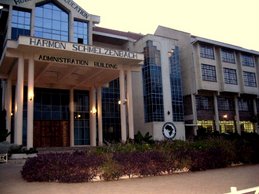
Welcome to our Blog! What are the goals of "Africonnection"? To further the Kingdom. To help North American friends make a connection with the lives and experiences of their brothers and sisters in Africa. And to give North American friends an opportunity to partner with Africa Nazarene University as it supports the Kingdom through the Church of the Nazarene in Africa.

Mark and Nancy

Saturday, June 6, 2009

African Lives #2: Eugenio Duarte


On one of the last days of the Africa Region Leadership Conference in April, Eugenio Duarte took time from his very busy schedule to come for dinner at our house. Because he's a Cape Verdian, living most of his early life on an island, we had fish.

Dr. Duarte is a wonderful listener and a very gentle but strong man. We are honored to have him as our regional boss. In what follows, his words are in italics. Here's his interview...

Dr. Eugenio (ew-JEN-eeoh) Duarte (dwawrt) Africa Region Director for the Church of the Nazarene. He was born and educated in the Cape Verde (vaird) Islands and served as a pastor and district superintendent there before being appointed to field and regional leadership roles. He and his wife Maria Teresa have three grown children, and live in Johannesburg, South Africa where the regional office is located.

Infant mortality was a problem in Cape Verde, and it affected Eugenio Duarte’s family. In Cape Verde, medicine was not developed well enough so many children died. When I was born I had some health problems. I don’t think they thought I would survive, but I made it. We were five children, however before I was born I am told that there were eight children. So four of them had died and I am the last-born in our family.

My mother was a very hard worker who taught her children to be the same. She taught us to earn our living honestly and to give the best of ourselves to others. My father was a man of peace. He was a builder with people working for him. One day one of his workers offended him. He was hurt, but he did not tell us. A little later, the worker knocked at the door. When he was let in and shown to my father, he said, “I came to ask for forgiveness, for what I did to you.” And my father said, “Oh, I forgave you before even you came.” That is one of many situations that make me think of him as a man of peace

When Eugenio was six, his eighteen year old sister Magdalena (mag-dah-LAYN-ah), who was attending the Church of the Nazarene, was the instrument of a turning point in his life. It was

announced in church that a school was going to start, and they would like Nazarenes to bring their children. Magdalena decided that she would talk to my parents so that they would allow me to go to a Nazarene

school. She went and did my registration and they took me to school and that is how my connection with the Church of the Nazarene started. To prepare me for school, my mother had crafted a gray school bag for me. It was precious because my mother made it from some fabric she had received from my aunt in the US. I remember the first day of school, I grabbed the bag, because I did not want anyone to mess with it because it was so precious.

A meaningful illustration helped this island boy see his need for salvation. We lived in islands surrounded by ocean, and most of the time the ocean was not friendly. When I was 12, a missionary, Clifford Gay, came to visit the island. That day he was asked to teach in my Sunday school class. The lesson was simple but impressive. The missionary presented salvation as what happens when you are crossing the ocean and the boat sinks. Even if you have no one around who is able to save you, when you have a life preserver, you are safe. That’s how he presented Jesus who is there and ready when you need him. And so I found myself lost and I went to this little room with four other boys and we prayed for our salvation. And that changed my life forever.

When he first heard the message of holiness a devotional classic helped him with the question of earning salvation. At the age of 17 I was in Mindello (meen-DAY-loh) and heard a message of holiness. I was reading The Christian’s Secret of a Happy Life by Hannah Whitehall Smith. One passage made it clear to me that Jesus has already forgiven me and I asked myself, “Then why am I bothered so much if Jesus has done it?” In that room alone, I said, “Lord it is now. I want to leave it all in your hands.” That was another turning point in my life.

Dr. Duarte’s sense of God’s saving and sanctification was clear, but God’s call to the ministry was hampered by a sense of inadequacy. He had talked to his pastor about attending Bible college, but instead of enrolling he first applied to join the Portuguese Army, then worked in business, and finally took a government job on Maio (MY-ew) Island, where he met his future wife Maria Teresa in the local Nazarene church and applied for a government scholarship. It was at this point that the true course of his life was about to be decided and two new chapters of his life began. I had applied for an engineering scholarship from the independent Cape Verde government. I was going to Russia, and everything was set: invitation, passport, visa, and airplane tickets. The day before my departure I took my wife and went to say goodbye to friends. We passed by the Nazarene Church and empty parsonage. I had the keys so I said to my wife, “I feel like going inside and praying.” I asked the Lord to bless me. I said, “I cannot go if you do not bless me,” but he did not. He said, “If you love me, then stay here.” When I said yes I felt that I was a new person again. I stood and said to my wife, “We are not going to say goodbye to anyone because I am not going anywhere.” So, we went back home and I sent a telegram to my DS who had been my pastor when I was growing up. The telegram said, “Do you have a place for a student this October? I will want to join.” I got a reply from my DS who said, “I have been praying for this day for years. I could have not gotten any better news than this!” I went to the capital, to ask them to release me, and the man who was in charge said to me, “You Protestants think going to Russia is going to hell.” I said, “No sir, none of that came to my mind, I have a reason but I know you will not understand.” He asked me what my reason was, and I explained to him about my call to ministry. He said, “Oh, you are crazy! How can you miss this opportunity for higher education?”

Eugenio’s time at the Bible college was productive and successful, and soon drew to an end. After an initial successful preaching assignment, Dr. Duarte served the church as a teacher at the Bible college, pastor of the mother Church of the Nazarene in Cape Verde, and then as district superintendent, gathering many memories of God’s faithfulness in the midst of challenge.

In 1996 Dr. Duarte was convinced that his time as District Superintendent was coming to an end. He alerted his field director and communicated his willingness to move back into the pastorate. God had other plans, though, and Dr. Richard Zanner called him to be the Field Strategy Coordinator in Central Africa. This assignment was followed in a brief period of time by other assignments to lead the Portuguese-speaking field and then the French-speaking field in West Africa. When I was told I was needed to lead the West Africa Field, I went to my office and did something that I don’t usually do. I took the Bible and opened it randomly looking for guidance. I read Isaiah 41:10 “So do not fear, for I am with you; do not be dismayed, for I am your God. I will strengthen you and help you; I will uphold you with my righteous right hand.” It was doubly confirmed when I went to the room where my wife was and she had her Bible opened to Isaiah 41 as well.

Dr. Duarte’s connection with Africa Nazarene University became stronger when he became a Field Strategy Coordinator and as a result became a Board member. It helped me to know Professor Marangu better, to know the great leader she is, and to see her relationship with the students. We do not see that type of thing much in Africa...there is usually a distance between senior administrators and students. God is using her example to train leaders.

1n 2006 Dr. Duarte was asked to serve as the Regional Director for the Africa Region. It’s a job that you do not ask for like any other ministry. When the Lord calls you, you do it. If I did not know Dr. Louie Bustle and the fact that he is able to work with you and empower you I might not have taken the position. I knew that he was someone I could go to when I made mistakes and tell him, “These are the mistakes please help me.” I did not feel confident and that kind of relationship had to be in place for me to accept this position.

When asked for his insights on several topics, Dr. Duarte responded as follows:

  • About Holiness: Holiness is a lifestyle where we allow God to make us like him. And for that to happen it has a starting point but it is not just that one event. I think many people have failed to live the life of holiness because they feel that it is something that happens one time and it is done. We bring ourselves back to the Lord continually so he can keep empowering us. For many people in Africa they believe that once you are half religious then you are good. Africa does not need more religion because we have too many religions, we need something that changes people’s life. Holiness changes people’s lives. That is not a message that many people are willing to listen to because they know that Christ paid the price and they are not willing to pay the price. However, those of us who have paid the price can say that it’s a worth price.
  • About the African church: The partnership between the church in the West and Africa is growing in significant ways. There was a time when that partnership meant Westerners brought money. Now we are learning that it’s a relationship and it is much more than money which is one of the blessings of the global economic hardship. Now people are learning to understand that we can not wait for the west to give us, because what the west can give us we can also give to the west in some ways. For instance, in Africa we emphasize community rather than an individualistic approach to living. When I go to the US and visit churches people are warm and friendly. They really want you to be part of them and feel at home, but then after the service they do not have time to stay with you because they have to attend to many other things. In America you have clocks but in Africa we have time. In Africa, we make time to be with people and they become part of us in ways they were not before.
  • About a vision for the Church of the Nazarene in Africa: We have to have people who live a changed life, who are in revival mode, and willing for revival again and again. The vision that I have for Africa is that the church planting movement that has happened in the Horn of Africa will spread through all seven fields...the whole of Africa. This movement is not about us, it is God’s work. It is about allowing God to use us to make it happen. That’s why I invited Howie Shute to come work in the Regional Office to assist us. As I think about how we will make disciples, it is about people discovering what works in their own culture to build relationships. We cannot make disciples the same way that the west does it. I am an African so I will use a different way. We have some great traditional ways of doing it. We may not call it making disciples, but we bring people along by spending time with them. So I want us to explore those ways that God has given to us, and make use of them. And if we do it the way God wants it then the one million member goal we have for this continent is nothing. Actually, when I mention one million members, I always have someone tell me that number is too small. Now my language has changed; I talk about the first million.
  • About how the global church can pray: We need prayer for the vision to happen. We have an ambitious goal to train 20,000 leaders by 2012. Now we have less than 8,000 leaders and not all of them are trained. So we are believing that God will raise up leaders and those who will train, equip, and disciple them. We see ANU as a power house to help make that happen as we create systems that help us multiple ourselves.

Friday, May 8, 2009

African Lives #1: Fidele Samvura Senga--Beyond the Rwandan Genocide


As our readers know, we've been

asked to write a "missionary book" for NMI. It has been a deep personal privilege to sit around our dinner table or on our back balcony overlooking the Athi Savannah talking to committed, faithful people about their lives and beliefs. We'll be previewing some of the chapters with Africonnection readers before they go to NMI. The convention of what follows is that the narration is in BOLD and the words from the interviewees are in ITALICS.

Fidele Samvura Senga, the third child of a Nazarene District Superintendent, was born in a Nazarene church and school compound in Isenyi, Rwanda about 20

miles east of the border with the Democratic Republic of the Congo. After high school, he attended Africa Nazarene University where he will graduated with a Bachelor of Theology degree in May of 2009. While a student at ANU, he wrote a grant application for his church's affiliated orphanage and is helping to administer the grant and the orphanage as he completes his studies. (The picture of children and of a building are of the orphanage.)

Because of his work as a DS, Fidele’s father spent many weeks each year away from

home visiting churches, encouraging pastors, and seeing to the work of the district. Even so, some of Fidele’s best childhood memories are of his family and of his parents. Although it wasn’t important at the time, his father was a Hutu and his mother a Tutsi. My father used to be away for ministry but every time he could come he could gather us around the sitting room and ask each one of how the week was. My mother could give him a report both negative and positive and if it is punishment we were to get it there and then, and we moved on with life. My father always gave us a chance to challenge him. He could come and sit all of us around the table and tell us to state what we have seen too extreme on his side, so from there we saw him being like our elder brother than being our father. My mother could understand us more easily than our dad because our dad had to practice justice but my mum could exercise mercy.

Although today many Rwandans remember long periods of living with their

neighbors in peace, when the Rwandan president’s plane crashed in April of 1994, it reopened old disagreements between Tutsis and Hutus. In the four months between April and July of 1994, thousands of Tutsis and moderate Hutus were killed. Some estimate the final death toll as high as 800,000. Fidele and his family were caught in the violence. When the Rwandan genocide began, Fidele was up country at St. Andrews, an elite Catholic secondary school. After the president’s plane crashed in April 6th 1994, I had just joined Form One (9th grade), but when we heard that all the Hutus were to be killed we were called back home. The Catholic brothers used the school buses to take us to the doors of our homes. When I arrived at the Nazarene compound, there were between 70 and 100 young men with pangas (machetes) who came into the compound to look among the 300 students in our

Nazarene high school for those who were Tutsis. My father and some church leaders had just returned from morning prayers and were sitting outside. The young men said that they wanted to see all the invenzi, the cockroaches, which was the name they gave the Tutsis. My father joked with them, saying, “We do not keep cockroach here, we have students!” When some of the young men started threatening my father others started shouting, “This is our pastor! Stop threatening him!” So they went but still the tension was in the air and those who were in the compound had to find their way out of the country.

Outside of the relative safety of the Nazarene compound, the Rwandan genocide continued. As Fidele and members of his family left to find food and try to rescue people and later as they fled to the Congo, they saw disturbing and unspeakable sights.You could walk out of the compound and find people killed, to the extent it was like a normal thing to find a person lying down across the road dead. The place they were calling the District Commissioners place was really a cemetery run by people whose work was to kill people. Those who had cash could buy a bullet for quick death rather than being killed more slowly by the pangas. People were told to dig their own graves and then were buried while they were alive. A military commander who came to the cemetery found a Catholic archbishop and two priests being buried alive. When those burying them saw the military commander, some ran away and others were ordered to remove the soil, freeing the priests. We did not prepare to go to the Congo. We woke up at the middle of the night and joined the masses of people walking toward the border. That distance of 20 miles took us the full day to cross over. We walked tied together so that no one of us should get lost. You could hear many children shouting, “Mum!” because they had gotten lost. There were many people using the same path—perhaps as many as two million who went into exile at some point, including sixteen thousand Rwandan Nazarenes who made the trip under my father’s leadership.

The family stayed in the Congo until 1994 when Fidele’s father was invited to pursue a Master of Arts in Religion degree at ANU. Fidele’s father continued with his studies until 1996. Although it was officially two years after the peak of the genocide, there was still a struggle in Rwanda for leadership of government, business, and the churches. My father felt that he needed to go back, because there were some people who wanted to take over most of the institutions in the country. Because there was a leadership problem, the church in Rwanda was in trouble. In 1996, my father went back to Rwanda to help the church. Then, in November of 1997 as he was making plans to come back to ANU, he was killed as part of the disagreements about leadership of institutions in the country. My mother was with him and was beaten and unconscious for awhile, but they did not kill her because she was a woman. Later, we discovered that prior to my father’s death 14 young people from the church had been killed in the same disagreements.

After Fidele’s mother recovered, she returned briefly to Kenya to accompany the family back to Rwanda. Fidel’s mother was determined to redeem the family’s experience of the genocide, loss of their father and lengthy separation from each other and from Rwanda. My mother adopted a new lifestyle because she felt like she needed to bring us up in such a away we could forget the past and put our mind on God. So she is the one who was much encouraging us to be involved in the church and to understand how far we had come. And she felt that the only way should could is to pray and encourage us to do the same, even now she has set apart Tuesday as the day she prays for all of us as her children. For me, forgiveness has been a matter of accepting and not dwelling in the past and seeking a way of living a new life. So this idea of forgiveness, it took time for me and for the family members, we decided to do it as a family and let what happened be of the past and look forward for a better life.

A chance trip to a Rwandan Peace and Reconciliation conference brought Fidele into contact with an American Nazarene family who were so impressed with Fidele that they offered to pay for his University education and suggested he attend Africa Nazarene University. Fidele credits ANU with allowing him to meet Nazarene leaders from all over Africa and to sharpen his thinking and his skills. As we had done with other interviews, we asked Fidele some questions designed to encourage sharing some ideas from his own perspective as a young African Nazarene leader in training. Here are some excerpts:

· On moving from bitterness to forgiveness: When the genocide and the death of my father were happening, I did not have much understand of who God was. I did know that God was good. We expected the God of love to be on our side but it did not seem to be true. Even the people we expected to be on our side did not seem to be. I came a book that talked about understanding God. The author was saying that our mind is so much limited that we see thing happening around, and we do not seem to understand. It makes it clear that God does not change with what happens to our lives, he still remains God. His ways of doing things can change but for him he does not change. In that situation, it gave me hope, I was able to figure out that my mum could have died with my father but there is a reason why she is alive. The encouragement we get from mum has kept me moving. Faith with God and her involvement in ministry has helped God make sense to us. I know God loves me the same way he loves other people and He regards me as a special person.

· About what the African church can contribute to the global church: I think in Africa we have really responded to the call of the church as a community, which is one of the strengths of the African community. If our definition of a church is the coming together as a family to worship God, and we can see it lacking from our Western brothers because they are more event oriented and we are more oriented toward people and relationships which falls under social wholeness. If Africa can pass on to our Western brothers the real value of community it will be a good thing. It will make us feel that we all need each other. And the idea of where one comes from, or of white and black, will not be there because we will feel we are all the same.

· About missionaries:. In our church administration class at ANU, we asked one of our professors whether he thinks the church in Africa needs missionaries, and surprisingly he answered that the church in Africa needs missionaries who are born again. I think that was because he has stayed in Africa for long and he knows the challenges that are facing the church in Africa. I think what he meant is people who are willing to forget their identities and learn new ways of ministry; he meant people who can adopt to the fields that they are send into so that they can be more of a support to the fields that they are send into. Without the presence of missionaries one cannot sense the idea of the church being an international church. The idea is for the national church to be able to sustain itself both spiritual and financially

· On the message of holiness in Africa: What I understand about holiness is the desire to walk with Jesus. There are so many things we get from walking with Him. Like the things we get from the Bible, and the people we walk with, and even our community. The holiness theologians will come with many, many theological words explaining what holiness is instead of using a simple word. We are not talking about holiness because it is a denominational requirement but because it is what God expects us to live by. The best witness of our holiness life should be the people who are living around us. They will be able to say that we are Christians and Nazarenes, they will be able to experience and witness about our holiness life.

· About how people can pray for him: I need God to help in the message that I preach to people to be of relevance to them and I may be able to make it simple to them without necessarily complicating their lives.

Monday, April 27, 2009

Africa Region Leadership Conference Report


An Irish diarist wrote a short poem that we've quoted before but that's accurate these days: "A man who keeps a diary pays, due toll to many tedious days; but life becomes eventful then, his busy hand forgets the pen." It's taken us awhile to do the Leadership Conference post we promised because the Leadership Conference kept us so busy!

The Africa Region Leadership Conference was a gathering of 300 Nazarene leaders from all over Africa. Each daybegan with a devotional, followed by a plenary speaker and breakouts in the morning, and plenary and breakouts in the afternoon and ending with a preaching service in the evening. The days were 14-15 hours long, but very rich. Some highlights and pictures:

  • The first picture at the top is of our blue T-shirted (mainly) ushers--all ANU "Bachelor of Theology" students, ready to greet our visitors. The next three pictures are of Horn of Africa people. Sudan DS John Yual (left in patterned blue shirt), currently a student at ANU and one of the interviews we'll post later, greets a colleague upon arrival. The group picture is one Mark posted on Facebook, but we're still being taught by the joy of this group that lost eight of its members to Muslim and anamist persecution in 2008. The third picture is of a pastor from Ethiopia who is the "prayer warrior" for the Horn of Africa. Terry Barker, the Education Coordinator there, said this pastor climbs a sacred mountain in Ethiopia for a month several times a year to pray for the work of the Church and the Kingdom in Africa. Each time we begin to complain or to use "entitled" language, we will think of this group that is winning souls and starting churches in the midst of tremendous oppression.
  • General Superintendent Jerry Porter preached two really excellent sermons. The first one, more earnest and intense, talked about the fact that Jesus was tempted, and that only yielding to temptation is sin. He acknowledged both the crisis and on-going relationship aspects of sanctification, and quoted 2 Peter 1:3-4 as he reminded the audience that we have access to power as well as purity through if the Holy Spirit. In the second, funnier, sermon he encouraged unchanging principles and changing stratgies. One item: he said--don't you just hate those songs where you have to stand and sing the same words over and over? For example, let's all stand and sing this irritating song which repeats the same word 56 times (and then a pianist accompanied him in the singing of Handel's Hallelujah Chorus!)
  • Rev. Balibanga, from French Equitorial Africa, gave an excellent devotional one of the days. He pointed out that even in the 36 African countries where the Church of the Nazarene is active, the economic, racial/ethnic, and health problems of Africa exist. He said that the Church of the Nazarene must present the nations of Africa and the world not just with holy words, but with holy lives, and with a "new world order" built not on economic transformation or social transformation, but built on a testimony of radical spiritual transformation.
  • Mark Lowe, Field Strategy Coordinator, quoted George Whitfiled, the famous Methodist evangelist, who said Wesley was right in putting his converts into classes, and observed sadly that his own converts were "a rope of sand." Mark said that without a well-constructed discipleship program, converts from such evangelistic efforts as the Jesus Film were in danger of also being a "rope of sand."
  • Chanshi Chanda, the Field Strategy Coordinator from French Equitorial Africa, told the true story of an Imam to whom he witnessed and who was saved in a dramatic way. When he returned to his home as an Imam he was given the platform at his local mosque and preached the gospel there. He is now training to become a Nazarene pastor. His wife is not yet converted and, as one might imagine, is having a hard time accepting his conversion. They need your prayer.
  • In a breakout session, Chanshi said that if he were kicked out of the Church of the Nazarene at any point, he would leave everything but the message of holiness. He said, "Some of us treat holiness as a play word. We treat it as a toy to be played with, but the essence of Christianity is holiness." Chanshi studies online with a Jewish rabbi in Toronto, and says that God's intention for the Israelites is that they be holy and close to God. He said, "We need to take our message of holiness to heart. If we are not strivintg to maintain the church as pure as it can be, forget about 'ministry sustainability.'"
  • Mashangu Maluleka, the principla of Nazarene Theological College in Muldersdrift, South Africa, preached a powerful, very African sermon, about Moses and the stick. He said that Moses was an African boy. His point was that we need to recognize the resources God has put into our hands, and we need to recognize the "snakes" that need to be killed.
  • As you might imagine, there were many, many other good sessions, including presentations by Howie Shute, Dr. LeBron Fairbanks, Fili Chambo and several others.
  • We attended (and mainly listened) in fascinating breakouts where DS's from all over Africa talked about some of their challenges: how to make graceful leadership transitions in a culture where the chief stays in as long as he can and historically has killed rivals. How to make disagreements model holiness and encourage learning and growth. How to deal with members or associate members (policy differs across Africa) who have been saved and repented, but are dealing with the consequences of polygamous marriages.
  • In between sessions, we did interviews with Dr. Eugenio Duarte and the three FieldStrategy Coordinators who are graduates of ANU: Chanshi Chanda, FSC of French Equitorial Africa; Paul Mtambo, FSC of Central Africa; and Ermias Choliye, FSC of the Horn of Africa. We will be publishing blog posts based on each of those interviews and others we are doing, so we'll save that for a different time.
  • Below, some additional pictures "just for fun" (apologies for a couple of slightly out of focus but favorite pictures): Dr. Eugenio Duarte and delegates from Sudan; Rev Paul Mtambo, Field Strategy Coordinator of Central Africa (in tan suit); lady drummer from the Horn of Africa; small part of an end-of-conference group photo; we'll blog more pictures at a later time."